AnyChat Review: Is This $29 Live Chat Tool Worth It?
AnyChat is a feature-packed live chat widget with AI assistants, multi-channel support, and a built-in CRM — all for a shockingly low lifetime price on AppSumo.

AnyChat
A live chat widget and unified messaging platform that lets you engage website visitors through chat, social media, forms, and AI assistants.
Agencies, local businesses, and power users who want a customizable all-in-one chat and support widget for their websites.
Charla, Crisp, TalkTo, Tidio
What Is AnyChat?
AnyChat is a live chat widget you embed on your website to engage with visitors — but calling it just a "live chat tool" seriously undersells what it does. It's more of an all-in-one communication hub that sits in the corner of your site and connects visitors to live chat, social media channels, contact forms, phone calls, SMS, and even AI-powered assistants.
It's currently available as a lifetime deal on AppSumo, and if you've been following the live chat space, you might remember Charla — a similar tool reviewed just a week prior. Many viewers requested a head-to-head look at AnyChat, and for good reason. While Charla focused on simplicity and clean design, AnyChat swings hard in the other direction: deep features, extensive customization, and a power-user mentality that becomes obvious the moment you log in.
Plans and Pricing: Almost Too Cheap
AnyChat's pricing on AppSumo starts at just $29 for a lifetime deal, which is eyebrow-raisingly cheap for what you get. Every plan includes unlimited everything — unlimited widgets, unlimited chats, unlimited channels — with the only differentiator being the number of chat agents.
Tier one gives you five chat agents for $29. Tier two bumps that to 10 agents and throws in 15 agency client accounts for $58. Tier three removes all limits entirely: unlimited agents, unlimited clients, white labeling, and custom domain support for $87. For context, a comparable SaaS would typically charge $300 to $600 for that kind of agency-level access.
Honestly, the pricing is a bit concerning. When a tool is this generous at this price point, it raises questions about long-term sustainability. It's also worth noting that AnyChat is not an AppSumo Select deal, meaning it doesn't come with the "We've Got Your Back" guarantee. That doesn't mean you shouldn't buy it, but you should be aware there's slightly more risk involved compared to Select deals.
Setting Up Your Chat Widget
Getting started with AnyChat is straightforward. From the dashboard, you add a widget for each website you manage. Just give it a name, enter the domain (specifying HTTP or HTTPS), and save. You can add multiple domains to a single widget and optionally whitelist specific domains so the chatbot only runs where you want it to.
Once your widget is created, the next step is configuring channels — the different communication options visitors will see when they click the chat icon. This is where AnyChat starts to differentiate itself from simpler tools like Charla. Instead of just live chat, your widget can display social media messengers, social profile links, live chat, contact forms, click-to-call buttons, click-to-SMS, custom links, and more.
This flexibility makes AnyChat particularly appealing for agencies managing local businesses. Imagine a plumber's website where clicking the chat icon gives visitors the option to call directly, send a text, message on WhatsApp, or fill out a contact form — all from one clean widget.
Channel Visibility and Scheduling
One of AnyChat's smarter features is per-channel visibility scheduling. Each channel you add to your widget can be configured to display only during specific hours, which opens up some practical workflows.
For example, you could set live chat to appear from 9 AM to 5 PM when agents are available, and automatically swap it out for a contact form during off-hours. The visibility settings give you four options for what happens when a channel isn't available: hide it entirely, show an offline badge, disable it, or both badge and disable. Setting up the inverse schedule on your contact form means visitors always have a way to reach you, and you never have to manually toggle anything.
Contact Forms and Custom Forms
AnyChat ships with three built-in form types: a callback form, an email form, and an offline form. These cover most common scenarios, but you're not limited to them. The form builder lets you create as many custom forms as you need, with a straightforward drag-and-drop interface for adding fields.
Forms integrate directly with AnyChat's contact and ticketing system, so submissions don't just sit in a void — they create actionable records you can follow up on through the platform itself.
Deploying the Widget on Your Site
AnyChat gives you four different embed options depending on how you want the widget to behave. The default is the menu button widget — the icon that opens a menu of channels. If you'd rather skip the menu and go straight to live chat, there's a dedicated live chat widget script. There's also a direct link option if you don't want an embedded widget at all and just want to link to chat from a button or menu item.
The fourth option is the admin widget, which is a clever touch. You embed it in your site's admin area so that logged-in administrators can monitor and respond to chats without ever leaving the website. Just make sure you only place it in authenticated areas — putting it on a public page would expose your API key.
For CMS users, AnyChat offers plugins for WordPress, PrestaShop, and OpenCart, with Shopify, Wix, Joomla, and Magento integrations listed as coming soon. Everyone else can simply copy the script tag into their site's header.
Integrations and AI Assistants
AnyChat's integrations page reveals a lot about the tool's identity. Front and center is an integration with Perfex CRM, a self-hosted CRM platform popular with power users and agencies. This pairing makes perfect sense — both tools cater to people who want deep control over their systems.
The AI assistant feature connects through your own OpenAI API key (not a ChatGPT account). You can create multiple assistants, choose which model they use, and train them by uploading files, pointing to specific URLs on your site, or leveraging AnyChat's built-in knowledge base. The one friction point here is URL entry — you have to paste them in one at a time. There's no sitemap import or CSV upload, which becomes tedious if you've got a large site. It's functional, but it's an area that could use improvement.
Live Chat Experience
When a visitor initiates a chat, managing the conversation is clean and intuitive. The chat interface shows the conversation front and center, with a right sidebar displaying visitor details like timezone, IP address, and device type. You can ban problematic visitors with one click, and you can create support tickets, tasks, or meetings directly from an active chat.
AnyChat also separates internal notes from team comments. Notes are visible to you and your team as a reference but stay tucked away in their own tab. Comments, on the other hand, appear inline with the conversation — useful for real-time team collaboration on a tricky customer interaction without the visitor seeing any of it.
Meetings and Task Management
AnyChat includes a basic meeting scheduler that lets you create meetings with contacts directly from a chat. You can specify attendees, location (Google Meet, Zoom, etc.), paste in a meeting link, set a date and duration, and save it. However, it doesn't actually integrate with calendar or meeting platforms — it's essentially a record-keeping tool rather than a true scheduling integration.
It's a nice feature to have, but it would be significantly more useful if it could create Google Calendar events or Zoom meetings automatically. As it stands, it's more of a reminder system than a scheduling tool.
Chat Flow Builder
The chat flow builder is where AnyChat's power-user DNA really shows. Think of it like the old Facebook Messenger bot builders — you create automated conversation flows with triggers, conditions, and actions that run before a human agent takes over.
The visual flow builder uses a node-based interface where you connect triggers to actions. It's capable but complex, probably a seven or eight out of ten on the difficulty scale. The interface has some rough edges: new elements can overlap existing ones, multi-selection behavior when dragging can be finicky, and there aren't any pre-built templates to help you get started. Documentation exists, but some in-app guidance or starter templates would go a long way toward making this feature more accessible.
Contacts, Organizations, and CRM Features
AnyChat tracks every visitor to your site and automatically promotes them to a contact once they engage with the widget. The contacts section functions like a lightweight CRM — you can view chat history, form submissions, open tickets, tasks, and meetings all tied to a single contact record.
You can also group contacts into organizations, which is useful for B2B scenarios or agencies managing client relationships. The contact profiles are surprisingly detailed for a chat tool, offering more depth than some dedicated CRMs. Each contact record includes notes, activity history, and linked support tickets, giving you a solid 360-degree view of each relationship.
Ticketing and Help Desk
The built-in ticketing system works like a basic help desk. You can create tickets from chats, assign them to agents, track status, and attach files. Tasks work similarly, with their own attachment support. Both feed back into the contact record, so nothing gets lost.
On the email side, AnyChat supports custom SMTP for outgoing notifications and IMAP for incoming email-to-ticket conversion. The SMTP setup was tested and worked flawlessly. IMAP enables a workflow where customers can create support tickets simply by sending an email, without ever visiting your website or clicking on the chat widget.
Live Chat Integrations and Third-Party Providers
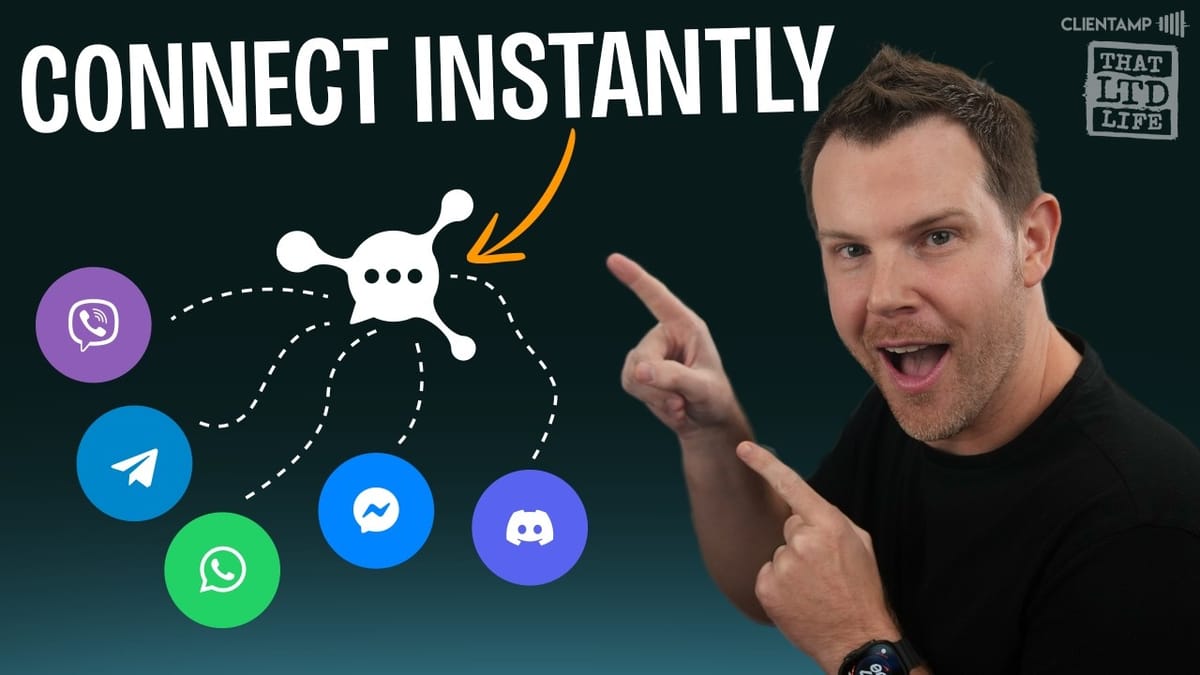
Here's where AnyChat's true identity becomes clear: it doesn't see itself as just a live chat platform. The live chat integrations section lets you connect social media messaging platforms — Facebook Messenger, WhatsApp, and others — into a unified inbox. You can reply to messages from all these platforms without leaving AnyChat.
Even more interesting, under widget settings you can swap out AnyChat's built-in live chat engine for third-party providers like TalkTo or Crisp. This means AnyChat can act as a wrapper or intermediary — you keep using a chat provider you already trust while gaining all of AnyChat's extra features like channel management, forms, scheduling, and CRM functionality. It's a smart architectural decision that lowers the switching cost for teams already invested in another platform.
Customization and Appearance
AnyChat provides granular control over the widget's appearance. You can customize colors, icons (choosing from built-in SVGs or uploading your own), and size — with four options ranging from "really huge" to "probably too small." Desktop and mobile get separate customization settings, and you can disable the widget on mobile entirely if you don't want it eating up precious screen real estate on smaller devices.
The button mode can be set to menu (default), callback only, or single channel, giving you control over the initial interaction. That said, the out-of-the-box visual polish doesn't quite match Charla's cleaner aesthetic. Charla looks better by default; AnyChat requires more manual tweaking to get the same level of visual refinement on the visitor-facing side.
Apps, Plugins, and Knowledge Base
AnyChat has native apps for both Android and iOS, so you can manage chats on the go. On the CMS side, WordPress, PrestaShop, and OpenCart plugins are available today, with Shopify, Wix, Joomla, and Magento integrations on the roadmap.
The knowledge base builder lets you create help documentation directly within AnyChat, which can also be used to train the AI assistant. The builder uses a block-based editor with headers, paragraphs, alerts, images, links, code blocks, embeds, and dividers. It gets the job done, though it feels a bit dated compared to modern editors like Lexical that tools like Charla use.
AnyChat vs Charla: Which Should You Choose?
AnyChat and Charla occupy the same space but serve different audiences. Charla is simple, visually polished, and easy to set up — ideal for small businesses or anyone who wants a clean live chat widget without a learning curve. AnyChat is the power user's choice: deeper features, more customization, CRM functionality, chat flows, AI assistants, and multi-channel support, but with a steeper learning curve and rougher visual edges.
At these prices, it's almost tempting to pick up both — something rarely recommended, but both deals are so inexpensive and so generous that having a backup isn't a bad idea. If you're an agency managing multiple clients or a business that needs advanced automation and channel management, AnyChat is the stronger pick. If you just want a beautiful, simple chat widget, Charla wins on aesthetics and ease of use.
Final score: AnyChat earns an 8.3 out of 10 — equally as capable as Charla, just aimed at a different type of user. The feature depth is impressive, the pricing is almost unsettlingly generous, and if the team behind it can sustain the business, it's an outstanding value for agencies and power users alike.
Watch the Full Video
Prefer watching to reading? Check out the full video on YouTube for a complete walkthrough with live demos and commentary.