AppSumo Black Friday 2024 Drop 4: 7 Lifetime Deals Reviewed
The final AppSumo Black Friday 2024 drop brings seven brand new lifetime deals. Here's a full breakdown of every tool, what it does, who it's for, and whether it's worth your money.

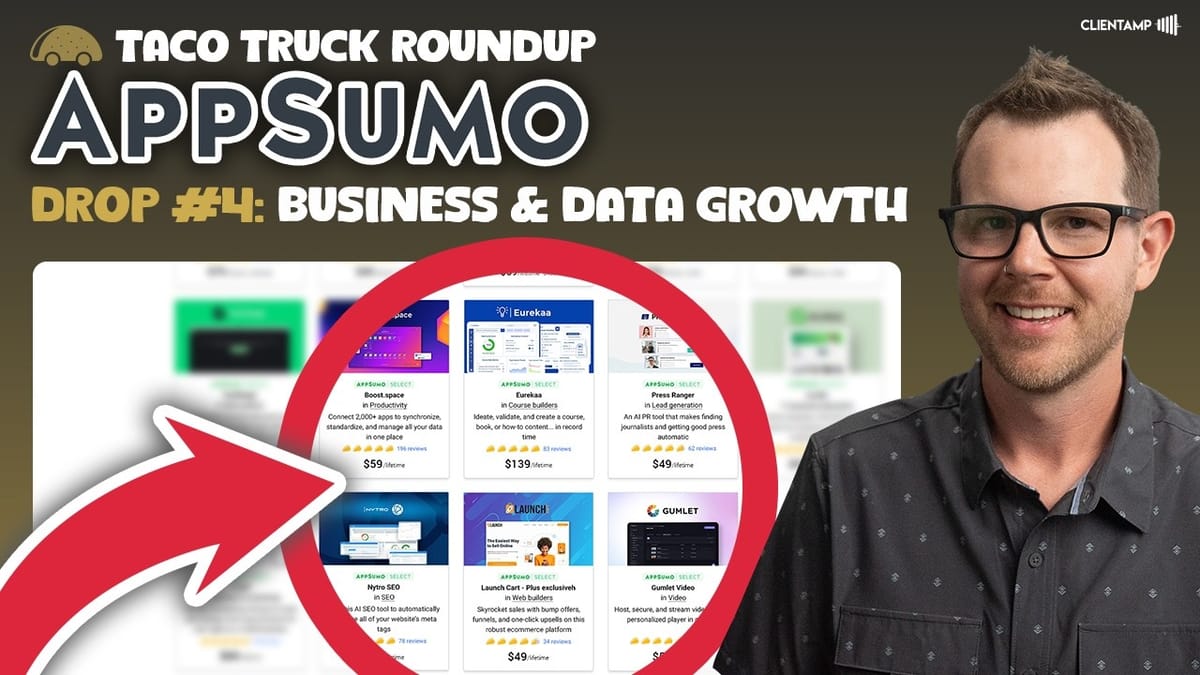
The Final Black Friday Drop Is Here
AppSumo's Black Friday 2024 event has been an absolute marathon, and Drop 4 is the grand finale. Seven brand new lifetime deals just landed, and some of them are genuinely impressive tools you may not have heard of before.
This roundup covers every deal in the drop with honest scores, pricing breakdowns, and practical insights on who each tool is actually built for. Whether you're looking for an integration platform, an AI voice agent, or a full e-commerce solution, there's something in this batch worth a serious look. Let's get into it.
Boost.Space: Your Central Data Hub (8.8/10)
Boost.Space is back on AppSumo after a brief earlier run, and it's making a strong case for itself this Black Friday. Think of it as an integration platform similar to Zapier, but with a critical difference: a cloud database sits at the center of everything. Data flows in from your various apps, lives in one centralized location, and can be pushed back out to wherever it's needed.
The core concept revolves around "modules" — essentially databases for specific data types like contacts, invoices, orders, products, and tasks. You pull data in via "data sources" and send it out via "data shares." The integration builder works like a visual flow builder, and there's a genuinely useful AI feature that automatically maps fields between applications. If you've ever spent an afternoon manually matching "email" to "email" and "first_name" to "first name" across hundreds of columns, you'll appreciate this.
What makes Boost.Space compelling is the idea of having a single source of truth for your business data. Instead of information scattered across a dozen SaaS tools, everything syncs to one place. It takes a somewhat technical mind to master, but you don't need to be a developer. Use cases range from syncing SEO metadata across your product catalog to automatically routing form signups into your sales CRM.
Pricing starts at $59 for tier one (50,000 operations/month, 5,000 records), but that introductory price is only available for 48 hours. Tier three and four are worth considering if you already have a revenue-generating business, as they include custom modules and higher limits. All plans include unlimited team members — only administrator seats are restricted. This is a serious infrastructure tool, and locking in a lifetime deal now could save you from expensive developer costs down the road.
Eurekaa: Course Research and Creation Tool (7.3/10)
Eurekaa is a niche tool designed for people who want to create online courses. It handles the full journey from market research and idea validation through to AI-generated course outlines and lesson content. At $139 for a single plan, it's a focused investment for a focused purpose.
The research side is where Eurekaa shines. You can search across platforms like Udemy, LinkedIn Learning, and Skillshare to see how many courses exist on a given topic, how many students are enrolled, and what the average pricing looks like. It generates an opportunity score (anything over 60 is considered viable) to help you gauge market demand versus competition. There's also book research functionality, which is smart — many successful course creators start with a book to build credibility before launching a premium course.
A couple of standout features include the AI Gap Analysis, which examines existing courses and identifies what's missing, and the AI Review Analysis, which mines student feedback to surface what people love or hate about competing courses. You can save interesting courses to a library, tag them for organization, and even install a Chrome extension to clip research from anywhere on the web.
There are some caveats with the data, though. The revenue estimates can be wildly misleading — Eurekaa might show a Udemy course listed at $95 with 46,000 students and calculate $4.3 million in revenue, but anyone who's used Udemy knows courses frequently sell for $12.99 on sale. The information is useful, but you need to apply common sense. The lesson architect feature can generate full course outlines with customizable parameters like module count, course length, and practical-versus-theoretical balance. It's a solid tool for serious course creators, though most people would be better served by starting with one course on a subject they're genuinely passionate about rather than research-first, produce-second.
Press Ranger: PR Outreach Made Simple (8.3/10)
Press Ranger tackles something most small businesses completely overlook: press outreach. The tool provides a massive database of journalists, publishers, and podcasts, combined with cold email outreach capabilities and even AI-powered press release generation and distribution.
The workflow is straightforward. First, you add your company with basic details like name, sector, description, and logo. Press Ranger then starts suggesting relevant journalists and media contacts. The media database is filterable by type (publishers, journalists, podcasts), location, category, star rating, keywords, and even whether a podcast accepts guests. In testing, filtering for US-based technology and business podcasts with four-plus stars that accept guests and are actively recording narrowed results to a manageable 71 options.
Once you find promising contacts, you can add them to custom lists, mark irrelevant ones as "not a fit," and send templated cold emails directly from the platform. There's even a lightweight CRM with a Kanban board for tracking your outreach pipeline — from initial contact through to successful pitch. The press release generator is particularly handy: describe your announcement, let the AI draft it, edit as needed, and distribute through Press Ranger's network. The basic distribution package ($79) reaches over 300 outlets, while the premium package ($300) hits all the major names.
The AI campaign feature deserves a mention — it essentially automates the entire process. Give it information about your company, and it'll write the press release, draft email templates, find matching journalists, create a contact list, and handle outreach. One click does everything you'd otherwise do manually. Pricing starts at $49 for one company, scaling up to five companies at tier two (which adds CSV export for use with external outreach tools). This could genuinely be the foundation for a PR business if you scale to the higher tiers.
Nytro SEO: Automated Metadata Optimization (7.4/10)
Nytro SEO takes a very specific approach to search engine optimization: it automatically updates the metadata (titles and descriptions) on your website. If you've ever migrated between CMS platforms and lost all your meta descriptions in the process, you'll immediately see the value here.
Setup involves adding your website URL, entering target keywords, specifying your target locations and audience, and then installing a small code snippet on your site. That snippet gives Nytro permission to intercept your existing metadata and replace it with AI-optimized versions. There are two modes: static (updates metadata once and leaves it) and dynamic (continually revises your metadata to try to improve your search rankings over time).
The metadata management interface is genuinely useful. You can see all of your pages' optimized titles and descriptions on a single screen, toggle between the original and optimized versions, and manually edit anything you don't like. It intelligently inserts your target keywords where appropriate. There's also keyword monitoring built in, which is a nice bonus if you don't already have a dedicated SEO tool.
Pricing starts at $59 for tier one, which covers 80 monitored keywords and 500 web pages on a single website. Tier two opens up to five websites, and tier three handles ten. If you're a prolific content creator, pay attention to the page limits — a site publishing five posts per week will hit 500 pages quickly. Tiers four and five offer flexible page allocations (4,000 and 20,000 respectively) that can be distributed across any of your sites.
Thoughtly: AI Voice Agents That Actually Work (8.6/10)
Thoughtly is the standout surprise of this drop. It's an AI voice agent platform that can make and receive actual phone calls, and it sounds remarkably natural thanks to ElevenLabs powering the voice generation. This isn't a chatbot — it's a phone-based AI agent that can hold conversations, answer questions, and even book appointments.
Building an agent (which Thoughtly insists on calling a "thoughtly") starts with choosing a conversation type — general, sales, candidate screening, market research, virtual receptionist, and more. You pick a voice from ElevenLabs' library, set your language, and then connect a knowledge base (called "genius" in Thoughtly's terminology). The knowledge base can ingest text documents, URLs, audio, PDFs, and CSVs. Feed it your website and sales scripts, and the agent can pull information in real time during calls.
The agent builder is a visual flow editor. You define what the agent says at each step, add action nodes for integrations (like booking a Calendly appointment), and chain everything together. In a live test, the agent successfully greeted a caller, answered questions about lifetime deals by pulling from its knowledge base, and then seamlessly booked a Calendly appointment that actually appeared on the calendar. The conversation felt natural, with appropriate pacing and relevant responses.
There are some fun personality touches too — you can add background audio (call center ambience, for instance), keyboard typing sounds while the AI "thinks," and adjust humor and assertiveness sliders. Native integrations include HubSpot, Salesforce, Zendesk, Google Sheets, Trello, and webhooks, with Zapier covering everything else. You can even buy a local phone number directly through the platform and mask it with your business number.
Pricing is credit-based starting at $59, with inbound/outbound calls and phone number rental consuming credits. Tier two is probably the minimum viable starting point to have enough minutes for real usage. The technology here feels genuinely forward-looking — more useful and honest than AI-personalized video, and a real glimpse at where business communication is heading.
Launch Cart: Feature-Rich E-Commerce on a Budget (7.2/10)
Launch Cart is a $49 lifetime e-commerce platform that competes with Shopify and WooCommerce, and it packs a surprising amount of functionality right out of the box. The catch? It needs some polish, and first impressions can be rough.
The backend dashboard looks dated, which is immediately off-putting for an e-commerce tool where aesthetics matter. But the store themes themselves are actually decent — the Launchpad theme in particular looks modern with a clean layout. There's a theme editor with toggle-based customization (sticky headers, light/dark footers, social icons, color palettes), and you can inject custom CSS for finer control. Just be aware that the homepage is off by default on all themes, which means new users see a bare shop page and might think the tool looks worse than it actually is.
The feature list is genuinely impressive for the price point. Built-in abandoned cart email sequences, customer review widgets, a promo bar, email list-builder pop-ups, and — most notably — sales funnels with bump offers and post-checkout upsells. These are features that would cost significant money as add-ons on Shopify or WooCommerce plugins. Product creation supports both standard products and print-on-demand via Launch Collective, Printful, and Printify. Payment processors include Stripe, PayPal, Pay Theory, and a few others. And critically, there's a 0% platform fee — Launch Cart doesn't take a cut of your revenue.
The weaknesses are real, though. The page builder is bare-bones and occasionally buggy. There's no apparent way to import existing products from other platforms, which is a major miss for anyone considering a migration. And while the tool does custom pages, they're not good enough to replace a proper website — you'll want another platform for your blog and marketing content. Tier one ($49) gets you one store with five pages and three upsell flows. Tier two opens things up considerably with 25 pages and 10 funnels. Higher tiers scale to 200 stores, making it potentially viable for building client e-commerce stores.
Gumlet Video: Fast, Secure Video Hosting
Gumlet Video rounds out Drop 4 as a secure online video hosting platform. It's designed for situations where YouTube isn't the right fit — online courses, client deliverables, website embeds, and any scenario where you need control over your video content.
The platform organizes content into libraries and collections, making it easy to separate videos by client, course, or project. Uploading is fast, with support for drag-and-drop as well as direct imports from Dropbox, OneDrive, Google Drive, Vimeo, S3, and even Wistia. That last one is notable — if you're paying Wistia's premium prices, migrating to Gumlet could save you a significant amount of money.
You can create playlists from your uploaded videos, which is particularly useful for course creators who want to organize content into a structured viewing order. The platform includes DRM protection and domain-level restrictions, so you can lock down your videos to only play on specific websites — essential for paid content. There's also a video player that's customizable with your branding, and the streaming quality automatically adjusts based on the viewer's connection.
Gumlet positions itself as the practical middle ground between free platforms like YouTube (where you sacrifice control and deal with ads) and expensive enterprise solutions like Wistia. For course creators, membership sites, and businesses that need reliable video hosting without recurring monthly fees, the lifetime deal pricing makes this worth a serious look.
Final Verdict: Which Deals Are Worth It?
Drop 4 wraps up AppSumo's Black Friday 2024 event with a strong lineup. The top scorer is Boost.Space at 8.8/10 — it's a serious data integration platform that could become essential infrastructure for online businesses. Thoughtly follows closely at 8.6/10 as the most exciting tool in the batch, delivering AI voice agents that genuinely work and sound natural. Press Ranger earns an 8.3/10 for making PR outreach accessible to small businesses that have been ignoring it entirely.
In the middle of the pack, Nytro SEO (7.4/10) and Eurekaa (7.3/10) serve more specific audiences — website owners who need automated metadata management and aspiring course creators doing market research, respectively. Launch Cart (7.2/10) packs incredible value for $49 but needs UI polish and an import feature to really compete.
Remember, AppSumo's site-wide sale typically puts everything at 10% off, so if any of these caught your eye, it's worth acting quickly. Every deal linked in the description supports the channel if you decide to pick something up.
Watch the Full Video
Prefer watching to reading? Check out the full video on YouTube for a complete walkthrough with live demos and commentary.