5 AppSumo Deals Reviewed: Humata, Adsby, Wiin.io & More
Dave puts five AppSumo lifetime deals through the paces — from AI-powered document analysis and Google Ads optimization to SMS marketing with your own Android phone.

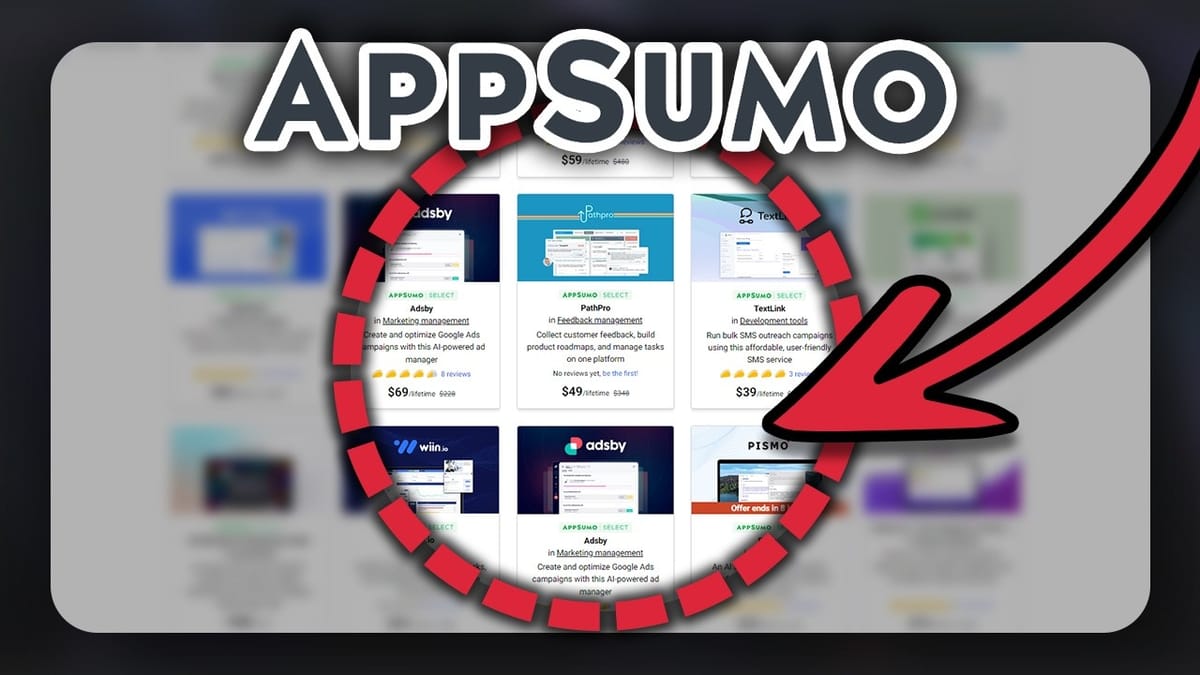
This Week's Taco Truck Roundup
Welcome to another Taco Truck Roundup, the weekly show where Dave reviews the most noteworthy lifetime deals on AppSumo so you can make smarter buying decisions for your business. This week's lineup covers five tools spanning AI document analysis, Google Ads management, form building, product roadmaps, and a creative take on SMS marketing.
Each tool gets a hands-on walkthrough, a score out of 10, and real community feedback pulled straight from the YouTube comments. Whether you're a solopreneur looking to streamline your stack or an agency hunting for client-ready tools, there's something worth a closer look in this batch.
Humata: AI-Powered Document Chat and Analysis
Humata is an AI document chat tool that lets you upload PDFs, text files, and even YouTube URLs, then have a conversation with that content using AI. What sets it apart from simply pasting text into ChatGPT is that Humata acts as an intermediary between your files and the language model. It feeds only relevant portions of a document into the context window as needed, effectively giving you unlimited context — so even very large documents can be analyzed without hitting token limits.
When you ask a question, Humata can highlight the specific section of a document where it pulled its answer, which is a nice touch for research and verification. You can chat with multiple files at once by selecting them individually or organizing them into folders. Team plans unlock shared folder access, letting you control which team members can see and chat with specific document sets — great for keeping personal research separate from collaborative projects.
Developers get full API access for building on top of the platform, and website owners can embed Humata's chat widget directly on their sites using a simple iframe. Visitors can engage with documents without needing to sign in, which opens up interesting use cases for customer-facing knowledge bases. In testing, the reference highlighting didn't always work perfectly, but results were generally solid. File uploads supported documents up to around 2,000 PDF pages, with no limit on the number of files you can add.
The most common question from viewers was how Humata compares to tools like Google's NotebookLM, Add4E, or PaperGuide. The differences are subtle — much like choosing between MailChimp, ActiveCampaign, and Kit for email. Humata's standout strength is its team collaboration workflow: adding files to folders, sharing them, and controlling access is fast and intuitive. Room for improvement includes a browser extension and a desktop app for easier file ingestion. Dave gave Humata a 7.7 out of 10.
Adsby: Simplified Google Ads Creation and Optimization
Adsby is an AI-powered tool designed to make creating and optimizing Google search ads dramatically easier than using Google's native interface. Dave set up a fresh Google Ads account specifically for the review and found the contrast between the two platforms striking — even as someone experienced with Google Ads, the Adsby workflow was noticeably faster and more intuitive.
The tool shines for non-PPC professionals who want to run effective search campaigns without the steep learning curve. After you create a campaign (or connect existing ones), Adsby delivers daily optimization recommendations. Dave noted that he trusts these suggestions more than Google's own recommendations, since Google has a financial incentive to maximize your ad spend regardless of whether you're hitting your conversion goals. Adsby, as a third party, is more aligned with actually improving your campaign performance.
One important limitation: Adsby currently supports Google search ads only. Video ads (YouTube) and display ads are not included, though Dave expressed hope that these formats would be added in the future. The pricing tiers are based on monthly ad spend — tier one covers up to $5,000 per month, with unlimited ad spend unlocking around tier four. That's notably generous compared to other PPC tools like Optimizer, which can rack up significant fees at higher spend levels.
An interesting workflow emerged from the community: pairing Adsby with AdAlchemy (reviewed the previous week). AdAlchemy offers more powerful campaign creation tools but doesn't connect directly to Google Ads, requiring manual export and import via Google Ads Editor. The suggested combo is to build campaigns in AdAlchemy, then use Adsby for ongoing optimization and daily recommendations. It's a power-user setup, but a productive one for agencies. Dave gave Adsby an impressive 8.4 out of 10.
Wiin.io: Form Builder and Submission Management
Wiin.io (spelled with two I's) is a form builder and submission management platform that AppSumo positions as a client portal. The concept is solid: create forms to collect submissions, applications, or contest entries, then manage and even publicly vote on them. It packs in a surprising number of features — unlimited forms and submissions, built-in payment processing, public voting for contests or hackathons, automated email drip sequences, CSV import/export, team collaboration, and a gallery feature for showcasing top entries.
The public voting capability is particularly interesting for running design contests, hackathons, or any scenario where you want community input on submissions. The automation builder for email notifications was reasonably well-executed, and the gallery feature provides a clean way to highlight winning or standout entries without opening up full public voting.
Unfortunately, the execution didn't quite match the ambition. The tool was built by a French development team, and the English translation was inconsistent throughout the interface — both on the backend for administrators and on the front end for users submitting forms. While some buttons and labels could be translated, enough untranslated or awkwardly phrased elements remained to create confusion. The UI also felt dated, with unnecessary extra clicks in the submission flow and a general lack of polish.
The core idea has real potential in the AppSumo marketplace, but it needs a significant UX overhaul and thorough localization work before it's ready for a broader audience. Dave gave Wiin.io a 5.9 out of 10.
PathPro: Roadmaps, Changelogs, and Feature Voting
PathPro is a tool for collecting user feedback, displaying public product roadmaps, and publishing changelogs. It's aimed squarely at software developers and product teams who need to keep users informed about what's changing and what's coming next. The biggest selling point is price — competitors in this space can run hundreds of dollars per month, so a lifetime deal makes it tempting to overlook some rough edges.
The feature set includes Reddit-style feature voting where users can submit and upvote ideas, release notes that can highlight specific community-suggested features (a nice community-building touch), and a slide-out news panel for product announcements. Team collaboration and custom domain support round out the offering. Dave compared the news panel concept to Beamer, which AppSumo itself uses — but PathPro's implementation falls short, delivering announcements in plain text with no support for images, video, or rich formatting.
The cons were hard to ignore. The UI feels dated and needs modernization. Some features didn't work at all during testing — user banning, for example, threw a series of error messages. The interface also felt sluggish, with noticeable delays on actions like upvoting. Customization is limited to CSS injection, which won't be enough to fundamentally restyle the platform.
Dave's scoring philosophy got an interesting discussion in the comments: tools scoring in the 8s and 9s have mass appeal and can replace mainstream SaaS products. 7s are decent lifetime deals with some compromises. 5s and 6s aren't necessarily bad, but expect to put in some work to get them functioning the way you need. PathPro landed at 6.6 out of 10.
TextLink: SMS Marketing Through Your Own Android Phone
TextLink takes a genuinely creative approach to SMS marketing. Instead of routing messages through Twilio (the service that powers most SMS platforms and charges per-message fees), TextLink turns your Android phone into an SMS server. You install their app, connect your SIM card to the service, and then send marketing messages directly through your own phone's texting capability — eliminating per-message costs from third-party providers.
The platform offers three core capabilities: API integration for developers who want to connect TextLink to other software via webhooks, a simple bulk messaging interface where you upload a CSV of contacts and blast out messages, and two-way communication that could serve as a lightweight support desk. Unlimited team members are included, though the number of outgoing texts is capped based on your AppSumo tier.
The obvious limitation is that it's Android-only. iPhone users would need to buy a dedicated Android device — which doesn't have to be expensive, since even a cheap phone with basic texting capability will work. Just keep it plugged in and connected, since messages stop sending if the device loses power. There are also country-specific restrictions: a US SIM can only text other US numbers, and expanding to international audiences requires additional SIM cards.
Because Dave doesn't own an Android phone, he wasn't able to fully test the platform and opted not to give it a score. However, he praised the concept as genuinely innovative and worth watching. For businesses with high SMS volume and a willingness to self-host, TextLink could deliver significant savings over traditional Twilio-based solutions.
Final Verdict: Which Deals Are Worth Grabbing?
This week's standout is clearly Adsby at 8.4 out of 10 — a rare high score that reflects just how much easier it makes Google Ads for the average business owner. If you've ever been intimidated by PPC or frustrated with Google's native ad interface, this is the tool to grab. Humata at 7.7 is a solid pick for anyone doing heavy research or document analysis, especially teams that need shared access to AI-powered document chat.
PathPro (6.6) and Wiin.io (5.9) both have promising concepts but need more polish before they're ready for prime time. They're worth bookmarking if the use case fits your business, but go in with realistic expectations. TextLink is the wildcard — an innovative approach to SMS marketing that could save significant money if you're willing to dedicate an Android device to the task.
As always, if you're shopping on AppSumo, consider using Dave's affiliate links in the video description to support the channel and keep these daily reviews coming.
Watch the Full Video
Prefer watching to reading? Check out the full video on YouTube for a complete walkthrough with live demos and commentary.