7 AI Copywriting Tools Compared: Which GPT-3 Writer Wins?
After weeks of testing Jasper, Copysmith, Rytr, INK, Copy.ai, Nichesss, and Writesonic, Dave reveals blind test results and picks the best AI copywriting tool for every budget and use case.

The GPT-3 Revolution Is Just Getting Started
This is the grand finale of a multi-part series where I put seven GPT-3-powered copywriting tools through their paces. I've spent serious time inside each platform — writing product descriptions, testing AIDA frameworks, generating long-form blog content, and evaluating everything from output quality to user experience.
Before we get into the results, it's worth stepping back to appreciate just how quickly this technology is evolving. Around the same time I was running these tests, GitHub and OpenAI announced Copilot, an AI pair programmer that suggests lines of code as you work. OpenAI also unveiled DALL-E, a model that generates images from text prompts. GPT-3 is the engine behind all the copywriting tools in this comparison, and it's already branching into code generation, image creation, and conversational AI. The copywriting space is just one slice of a much bigger picture.
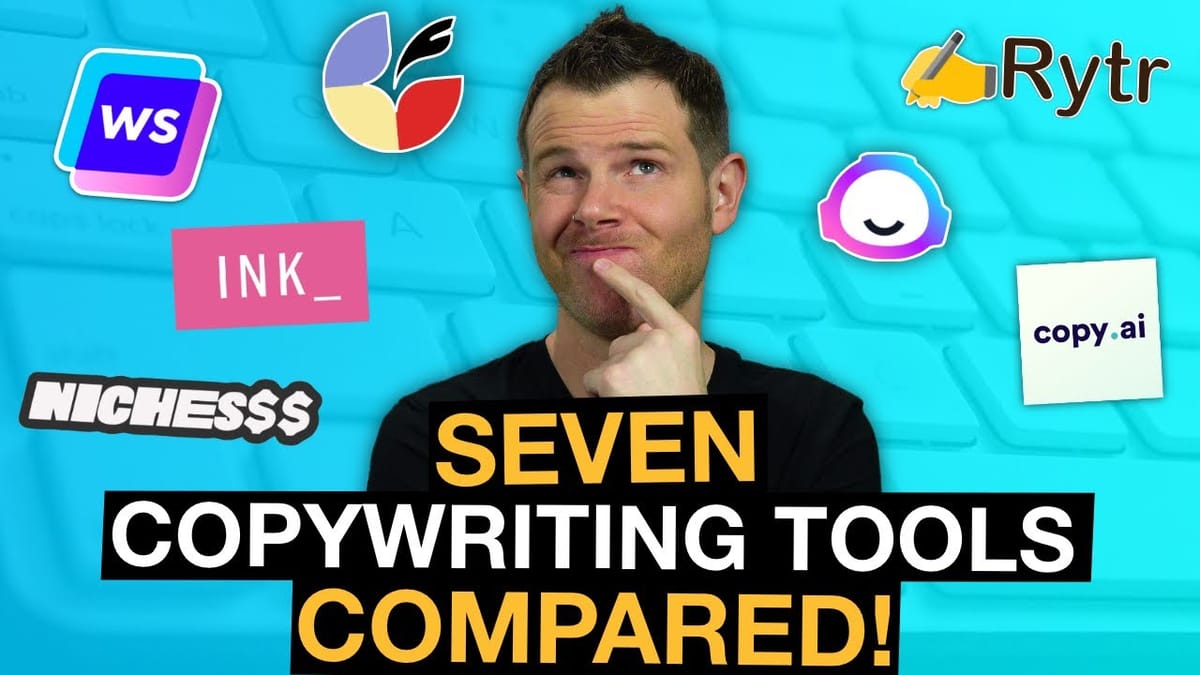
The seven tools I compared are Jasper (formerly Jarvis), Copysmith, Rytr, INK, Copy.ai, Nichesss, and Writesonic. Each one takes GPT-3 and wraps it in a different user experience with different templates, pricing models, and target audiences.
Blind Test: Product Descriptions
To keep things as fair as possible, I used the same inputs across every tool and didn't edit any of the outputs. The only exception was removing a person's name from one Jasper result that would have made the tool too obvious. Every other piece of text came straight out of the application, untouched.
I asked each tool to write a product description for Profitable Tools Insiders, a membership site with tutorials and guides for business software. The outputs ranged from punchy and benefit-driven to verbose and meandering. Some tools nailed the tone immediately — concise, focused on the reader's pain points, with a clear value proposition. Others produced text that read more like a rambling sales letter than a tight product description.
What surprised me was how differently I perceived the results when I stripped away the application's branding and interface. Reading the outputs side by side in a plain keynote slide, my preferences shifted compared to how I felt while using each tool. The environment you're writing in subtly biases how you judge the output — and since your audience will never see the tool's UI, that blind comparison is actually more useful.
Blind Test: AIDA Framework Results
The AIDA framework — Attention, Interest, Desire, Action — is a classic copywriting structure, and it's a great stress test for AI writing tools. For this comparison, I focused specifically on the Attention (headline) and Action (call-to-action) sections to keep the evaluation focused and comparable.
The results were all over the map. Some tools generated headlines that were specific and compelling — directly addressing a pain point or desire. Others produced generic attention-grabbers that could apply to almost any product. On the CTA side, one tool simply refused to generate a call to action at all, which is a pretty significant gap for a copywriting tool.
The strongest AIDA outputs paired a clear, benefit-driven headline with a specific, actionable CTA. The weakest ones either went too broad with the headline or produced calls to action that felt disconnected from the rest of the copy. This test really highlighted how different each tool's training and prompt engineering is, even though they're all running on the same underlying GPT-3 model.
How I Judged These Tools
My evaluation criteria went well beyond just output quality. I looked at five key areas: long-form blog content generation, short-form content like product descriptions and AIDA frameworks, originality (whether the content gets flagged as plagiarism), the number of features and templates included, and the overall user experience.
That last point — user experience — matters more than you might think. Some of these tools are genuinely enjoyable to work with. You open them up and want to start creating. Others feel clunky or unintuitive, and that friction adds up when you're using the tool every day. A copywriting assistant that you dread opening is a copywriting assistant that isn't going to get used, no matter how good the raw output is.
Best Value for Short-Form Content: Copysmith
If your needs are focused on short-form content — product descriptions, social media posts, ad copy — Copysmith offers the best combination of features, user experience, and price. At just $19 per month for 50 credits, it's accessible for solopreneurs and small teams doing e-commerce or social media marketing.
Need more volume? Their unlimited plan comes in at $59 per month, which is still very reasonable compared to the competition. The main limitation is long-form content. Copysmith's writing experience just isn't built for blog posts or articles right now. If you try to use it for that, you'll be fighting the tool instead of working with it. But for its intended purpose — cranking out short, punchy marketing copy — it's hard to beat the value.
Best Budget Pick for Long-Form Writing: Rytr
Rytr took an interesting approach that stood out from the crowd. Rather than building a traditional template-based interface, it focused on long-form content creation inside what's essentially a word processor. No bells and whistles — just you and the AI working together on longer pieces.
At $29 per month for unlimited characters, it's the most affordable option for anyone who primarily needs to produce long-form blog content or articles. That unlimited usage model is a big deal if you're producing content at volume. The trade-off is that the output quality isn't quite at the level of the premium tools. But if budget is your primary constraint and you need a long-form writing assistant, Rytr delivers solid value. It's also worth considering if English isn't your native language, as the tool can help bridge that gap in longer writing projects.
Best Multi-Tasker for SEO Writers: INK
INK is the dark horse in this comparison. It's very different from the other tools — it runs as a standalone desktop application rather than a web app, and it combines GPT-3 writing assistance with built-in SEO optimization features.
The ideal INK user is someone who's already an accomplished writer looking for SEO guidance with a side of AI assistance. If you're the type who mostly writes your own content but occasionally needs a nudge to get past a tricky paragraph or wants AI-generated ideas to riff on, INK fits that workflow well. The GPT-3 output quality doesn't quite match Jasper's, and the pricing starts to overlap with the premium tier, but INK bundles SEO analysis features that Jasper doesn't include out of the box. For content marketers who want writing assistance and SEO tools in a single package, it's worth a serious look.
Best Overall AI Copywriting Tool: Jasper
No surprise here — Jasper (formerly Jarvis) is the best overall product in this comparison. It handles short-form content, long-form content, and everything in between. It has the most templates, the most integrations, and consistently produces the highest quality output across different use cases.
That quality comes at a price. Most users will end up on the $119 per month plan to access the full feature set. You might think the starter plan will be enough, but the advanced features are genuinely compelling and hard to resist once you've seen what they can do. The tool also iterates at a remarkable pace — between the time I published one video in this series and recorded the next, Jasper had already shipped a brand new Recipes feature.
At $119 per month, Jasper might seem expensive until you consider what professional content creation actually costs. Hiring writers runs into thousands of dollars monthly. Jasper won't replace your need to do keyword research, understand your audience, or bring subject matter expertise — but it will dramatically accelerate the actual writing process and help you break through creative blocks.
Final Recommendations and Who Should Use What
Here's the quick summary of my recommendations. If you can afford it, go with Jasper — it's the most capable tool by a clear margin. Pair it with Surfer SEO and you'll get a writing experience similar to INK's integrated approach but with significantly better output quality.
If budget is tight and you're primarily doing long-form content, Rytr at $29 per month with unlimited usage is hard to argue with. For teams focused exclusively on short-form marketing copy — product descriptions, social posts, ad copy — Copysmith starting at $19 per month offers the best bang for your buck.
One important thing to keep in mind: none of these tools are a magic bullet. AI can help you write faster and overcome writer's block, but it can't replace the strategic thinking that goes into effective content. You still need to know your audience, do your research, and bring genuine expertise to the table. These tools accelerate the execution — they don't replace the strategy.
Watch the Full Video
Prefer watching to reading? Check out the full video on YouTube for a complete walkthrough with live demos and commentary.