Claude Max OAuth Locked Out: My New Open Source AI Stack
Anthropic updated their terms to block Claude Max OAuth tokens from third-party tools like OpenClaw and Open Code. Here is the full breakdown of what happened, why it matters, and the alternative AI coding stack I switched to.


Collect and showcase testimonials on your website with ease. Import from Twitter, LinkedIn, and other platforms, then display them as a wall of love or carousel. Right now there's a special lifetime deal for just $199.
📎 Tools Mentioned in This Video
What Happened With Claude Max OAuth
When Anthropic released Sonnet 4.6 with its impressive 1 million token context window, I was genuinely excited. Then I switched my agent over to the new model and everything broke. Authentication errors, OAuth tokens rejected — my entire workflow with third-party tools like OpenClaw and Open Code ground to a halt.
This wasn't entirely unexpected. Back on January 9th, Anthropic pulled something similar — they locked everyone out of using their Claude Max subscriptions with third-party services. The community pushed back, Anthropic loosened the restrictions, and things started working again. But this time feels different.
Here's the confusing part: the process to generate an OAuth token still exists. If you run claude setup-token in your terminal, Claude walks you through authenticating in your browser and generates what looks like an API key. The whole flow works perfectly. It's just that the key you get back can't be used anywhere except Claude's own products.
Anthropic's Official Policy Update
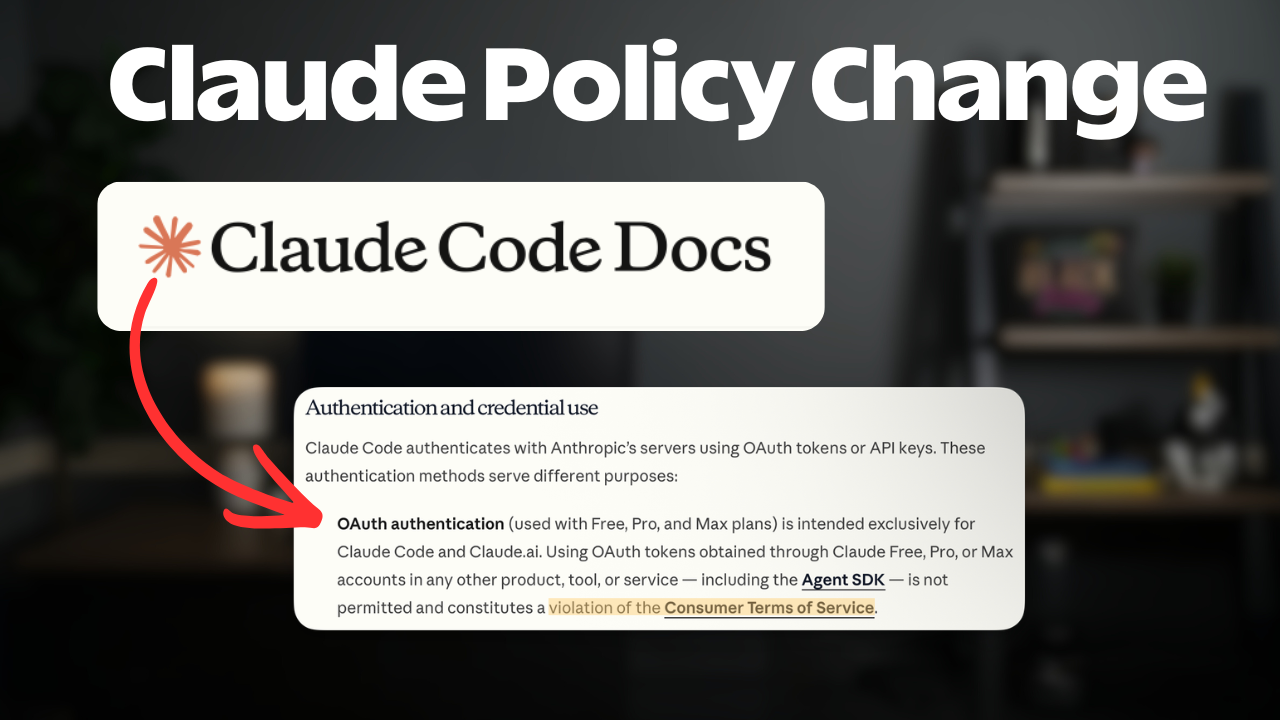
The Claude Code docs now state it plainly: OAuth tokens obtained through Claude Free, Pro, or Max accounts cannot be used in any product, tool, or service — including the Agent SDK. Using them in third-party tools constitutes a violation of the consumer terms of service.
What makes this so frustrating is the disconnect between policy and practice. When you install OpenClaw and run the configuration wizard, one of the first things it asks you to do is pick a provider. Choose Anthropic, and it prompts you to paste in your setup token. The tool literally expects it to work. And for many people, it still does — I just wasn't one of the lucky ones.
My Claude account wasn't banned. I can still use Claude Code and Claude Desktop without issues. It's specifically the OAuth tokens in third-party tools that stopped working. And honestly, that's one of the main reasons I was paying $200 a month for Claude Max in the first place.
Reddit Rumors and Account Bans
I wasn't the only one affected. Reddit lit up with reports of people running into problems. One user posted that they got banned for having multiple Claude Max accounts — they were literally trying to give Anthropic more money and got shut down for it. Another post described how their company's developers were told their Max 20 plans ($200/month each) wouldn't be renewed, and they'd need to switch to pay-as-you-go API pricing.
The pattern suggests Anthropic may have underpriced their Max subscriptions. The plans are generous enough that heavy users can consume far more than their subscription covers. My question is: why not just adjust the limits? Sure, people would complain, but transparent pricing changes beat silently cutting off access.
The Claude Max Pricing Problem
Six days before this all happened, Anthropic raised $30 billion in a Series G funding round at a $380 billion valuation. Those are staggering numbers. And yet they appear to be losing money on their consumer subscriptions.
Tariq from Anthropic's developer relations team posted that the documentation change was just a "doc cleanup" and that nothing was changing about how you can use the Agent SDK with Max subscriptions. That sounded promising. I tried my tokens again — same OAuth error. His replies encouraged "local development" and suggested businesses use proper API keys, which is reasonable. But he never directly answered the question everyone was asking: can we use our Claude Max subscriptions with OpenClaw and Open Code, or not?
It really feels like there's internal tension at Anthropic about where consumer subscriptions fit into their long-term business model. The AI world moves fast, and getting locked into one ecosystem that might shift direction is a real risk.
Switching to Kimi K2.5
With my Claude workflow broken, I needed an alternative. I landed on Kimi K2.5 from Moonshot AI. It's a model from a Chinese AI research company, and the price-to-performance ratio is hard to beat.
The numbers speak for themselves: Kimi K2.5 input tokens cost 10-12x less than Claude Opus 4.6, and output tokens are 10-14x cheaper. On benchmarks, Kimi is competitive across the board. Claude still edges it out in coding-specific tasks, but the gap is narrower than you'd expect given the price difference.
I threw $20 into Kimi to test it out and received a $5 bonus. After a full day of heavy usage, I'd spent about $10. If I kept that pace every day (which I won't), that's roughly $300 a month — and a normal workload would likely keep me well under the $200 I was paying for Claude Max. Moonshot also offers subscription plans from $20 to $200 per month if the pay-as-you-go approach doesn't work out.
Open Code — A Claude Code Alternative
The bigger lesson here isn't about any single model. It's about using tools you control. Open Code is an open source alternative to Claude Code that lets you plug in whatever model you want. If one provider rug-pulls you, switch to another without rebuilding your entire workflow.
Open Code works just like Claude Code. Install it from their website, navigate to your project directory, type open code, and connect your LLM of choice. It supports 75+ models including Claude, GPT, Gemini, and local models. There are desktop clients for macOS, Windows, and Linux. You can switch between build mode and plan mode with the tab key, just like in Claude Code.
One feature I really appreciate is real-time cost tracking. Open Code shows your spending right in the corner of the terminal as you work. With Claude, expenses were obscured until you checked the usage dashboard. Knowing exactly what each interaction costs changes how you think about your workflow.
Longer term, my plan is to self-host. When the next Mac Studio drops with enough shared video RAM, I want to run models locally using Open Code. No API keys, no subscriptions, no one to shut you off. That's the real endgame for anyone serious about building with AI tools.
Where I Go From Here
Here's the bottom line: I'm not done with Claude entirely. It's still one of the best models available, especially for coding. But I'm no longer going to build my entire workflow around a single provider's proprietary tools. The combination of Open Code + Kimi K2.5 gives me flexibility I didn't have before, and the open source foundation means I can swap providers whenever the market shifts.
If you're in a similar situation — paying for Claude Max and wondering if your access will be next — I'd encourage you to start experimenting with alternatives now. Check out Open Code and OpenClaw. Try Kimi K2.5 or another model through an open source client. The setup takes minutes, and having a backup plan is just good practice in this space.
I'll keep sharing what I learn as my stack evolves. If you've found other great open source AI tools, let me know in the comments — I'm always looking for new options.
Frequently Asked Questions
Can you still use Claude Max with third-party tools like OpenClaw?
Officially, no. Anthropic's updated documentation states that OAuth tokens from Claude Free, Pro, and Max accounts cannot be used in third-party tools or services. Some users report their tokens still work, but using them violates the consumer terms of service.
What happened with Claude Max OAuth tokens?
After the Sonnet 4.6 release, Anthropic began enforcing restrictions on using Claude Max OAuth tokens outside of their own products. The documentation was updated to explicitly prohibit third-party tool usage, and many users found their tokens no longer authenticated.
What is Kimi K2.5 and how does it compare to Claude?
Kimi K2.5 is an AI model from Moonshot AI, a Chinese research company. It costs 10-14x less than Claude Opus 4.6 per token while performing competitively on most benchmarks. Claude still leads in coding tasks, but the gap is narrow relative to the cost savings.
Is Open Code a good alternative to Claude Code?
Open Code is a strong open source alternative that supports 75+ models including Claude, GPT, and local models. It offers similar features to Claude Code — terminal-based coding, plan/build modes, and file management — plus real-time cost tracking and provider flexibility.
Can you self-host AI models for coding?
Yes. Tools like Open Code support local model providers. You need significant hardware — ideally a machine with large shared video RAM like a Mac Studio — to run models that match cloud-hosted quality. Open source models like MiniMax are making local hosting more viable.
How much does Kimi K2.5 cost compared to Claude?
Kimi K2.5 input tokens cost roughly 10-12x less than Claude Opus 4.6, and output tokens are 10-14x cheaper. A heavy day of usage costs around $10. Moonshot also offers subscriptions from $20 to $200 per month.
Will Anthropic ban your account for using third-party tools?
There are reports of accounts being restricted, but outright bans appear to be related to having multiple Max accounts rather than third-party tool usage alone. Still, using OAuth tokens in unsupported tools violates the terms of service and carries risk.