Keevi AI Review: Does This Video-to-Shorts Tool Actually Work?
Keevi AI aims to repurpose long-form video into short-form clips using AI, but the editing limitations and caption issues hold it back from being a reliable tool.

Keevi AI
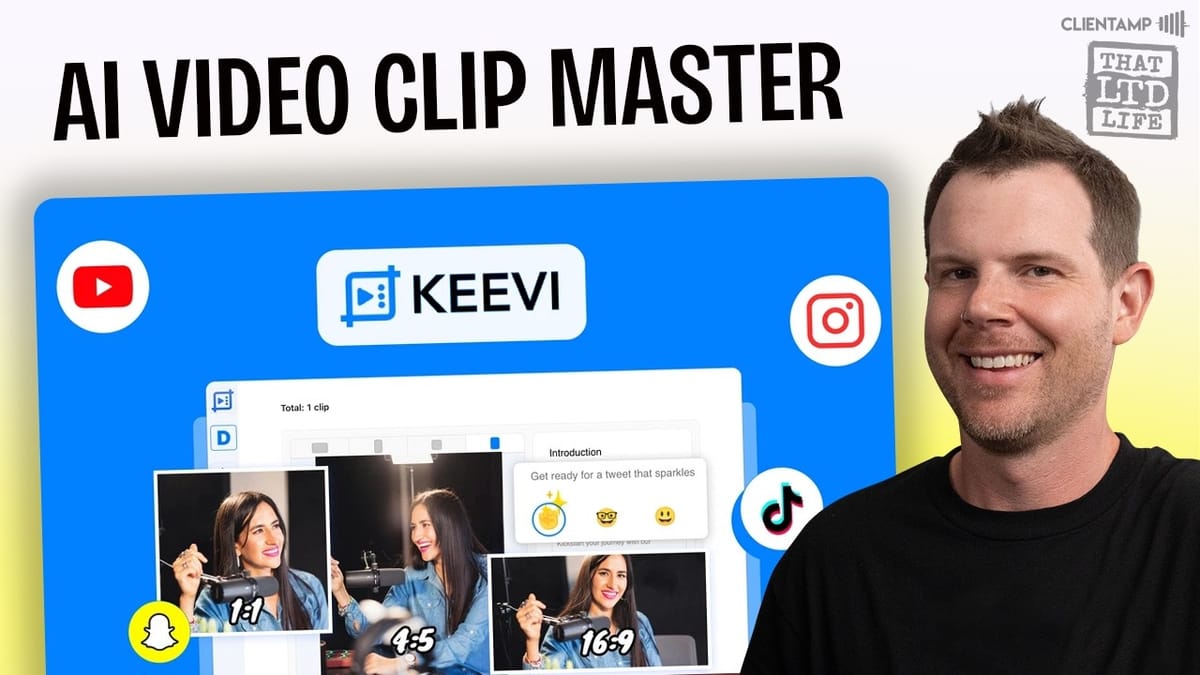
An AI-powered tool that takes long-form videos and automatically repurposes them into short-form clips with captions and auto-reframing.
Video creators and marketers who want to turn YouTube videos and other long-form content into shorts for TikTok, Instagram Reels, and YouTube Shorts.
Opus Clip, Vizard AI, Descript, Pictory
What Is Keevi AI and Why Does It Matter?
If you create long-form video content, you already know the problem: you should be repurposing those videos into shorts for TikTok, Instagram Reels, and YouTube Shorts, but you almost never get around to it. Keevi AI is an AppSumo lifetime deal that promises to solve this by using AI to analyze your videos, find the interesting moments, and automatically generate short-form clips.
The pitch is compelling — just hand over a YouTube link, and the tool does the rest. It picks out highlight-worthy segments, reframes the video for vertical viewing, adds captions, and gives you ready-to-publish shorts. That's the dream, anyway. The reality, as we'll see, is a bit more complicated.
Plans and Pricing on AppSumo
Keevi AI is available on AppSumo starting at $49 for the lowest tier, which includes 10 hours of video processing per month. That should be more than enough for most solo creators who publish a handful of videos each week. If you're running an agency or producing a high volume of content, tier four goes up to $600 but unlocks unlimited video hours.
The usage meter counts the total length of video you feed into the tool, not the output length. So a 47-minute video eats 47 minutes of your monthly allowance regardless of how many shorts it produces. That's worth keeping in mind if you're working with longer content.
Branding and Caption Settings
Before generating any content, you'll want to set up the branding section. This is where you configure captions, overlays, fonts, and colors that will apply across all your output. You can choose between "original lines" and "one line" caption styles, with the single-line option producing a cleaner, more compact look that works better for short-form content.
Caption positioning offers four choices: top, middle, bottom, or auto. The auto setting claims to dynamically place captions at one-third of the resolution, though the description in the app is vague and contains a typo — not a great sign. In practice, captions placed on auto didn't move around much at all, largely staying in the same position throughout each clip.
You can also upload a screen overlay like a logo, and there are about seven or eight font choices available. Font sizing is limited to preset values rather than custom pixel input, and some fonts lock you into bold. The color settings let you customize the font color, stroke color, AI keyword highlight color, and keyword stroke color. It's decent for basic customization, but everything is set at the account level — there's no way to override styles per video or per clip, which becomes a real problem with varied content.
Workspaces, Brands, and Folders
The interface hints at a workspace feature with a "default workspace" label and a disclosure triangle suggesting you could add more. However, on the AppSumo plan there's no way to actually create additional workspaces. The sales page doesn't mention workspaces at all, and no one in the reviews or Q&A has addressed it either. It's possible this is a planned feature or one reserved for a separate subscription.
There's also a white-labeling section under account settings where you can swap out the application logo and favicon — useful if you're running this for clients. You can organize projects into folders, which is a nice touch for keeping things tidy when you're processing multiple videos. But the brand settings remain account-wide, so switching between clients means manually changing your branding configuration each time.
Importing Videos and Processing Times
Getting a video into Keevi is straightforward. You can paste a YouTube URL or drag and drop a file directly into the browser. After entering a URL, the tool downloads the video and then uploads it to their servers for processing. You'll choose between standard, high, or best quality — with best taking longer to process.
Processing time is where patience becomes essential. A 47-minute video took a significant chunk of time, with the progress bar stalling at 75% for an extended period. The progress indicators are not particularly accurate, so don't panic if things appear stuck. An 11-minute video processed concurrently didn't finish noticeably faster, and both videos ended up neck-and-neck at the 75% mark for quite a while. You can navigate away from the page while processing happens, and Keevi will email you when it's done.
Choosing Your Timeframe and Language
Once the video is uploaded, Keevi asks you to specify a timeframe for generating shorts. You can trim out sections you know won't produce good clips — like a lengthy intro — or let it analyze the entire video. For a 47-minute video, trimming out the first minute of intro and letting the AI handle the rest seemed like a reasonable approach.
Keevi supports over 20 languages for translation and repurposing, so you could theoretically take an English video and produce shorts in Spanish, French, or other languages. The language selection happens at this stage before the AI begins its analysis. For most creators, sticking with your primary language makes the most sense initially, but the translation feature could be genuinely useful for reaching international audiences.
Social Media Integrations
While your video processes, it's worth checking out the integrations panel. Keevi connects to Facebook, TikTok, LinkedIn, Twitter, Instagram, and YouTube. The idea is that once your shorts are generated, you can publish them directly to these platforms without downloading and re-uploading manually.
This is a nice workflow improvement in theory — especially for TikTok, YouTube Shorts, and Instagram Reels where most short-form content lives. However, the value of these integrations depends entirely on whether the output quality is good enough to publish without further editing.
Auto-Reframing: How the AI Handles Vertical Conversion
The auto-reframing step is where Keevi uses AI to convert your 16:9 widescreen footage into 9:16 vertical format. This means the tool needs to identify the focal point in each frame — typically the speaker or the most relevant on-screen element — and crop accordingly.
This is genuinely difficult to do well. You're flipping the entire aspect ratio, which means significant portions of the original frame get cut. For talking-head content, the AI needs to consistently track the speaker. For screen recordings or demos, it needs to identify where the important information lives. How well Keevi handles this directly impacts whether the output is usable.
The Results: 24 Clips from a 47-Minute Video
The longer video produced 24 clips, which is a generous number. The shorter 11-minute video generated 5 clips. Quantity isn't the issue here — it's the quality that falls short in several important ways.
First, the auto-reframing didn't reliably center on the right content. A clip featuring an on-screen checklist, for example, wasn't centered on the checklist itself. There's no way to manually adjust the framing within the editor, so you're entirely dependent on the AI getting it right.
Second, the caption system has a fundamental flaw: colors are set globally with no per-clip overrides. A video with varied backgrounds — a white screen for a demo, then a dark shirt for talking head — means your caption color will be unreadable in at least one context. Changing to black text fixes readability on white backgrounds but makes captions invisible against dark clothing. There's no winning.
Third, the clip selection algorithm struggles with finding natural starting points. Clips consistently began with the tail end of a previous sentence rather than at a clear transition. Phrases like "the next step is" would appear mid-clip rather than at the beginning, creating an awkward viewing experience that makes you wonder what you missed.
The Editor: Functional but Limited
Keevi's built-in editor is where the tool's limitations become most apparent. You can switch between aspect ratios — 9:16 for shorts, 16:9 for standard, and a few others — but that's about the extent of useful editing.
The timeline shows your full source video with the clip highlighted, but there's no way to zoom in for precise trimming. With a 47-minute source video, trying to adjust clip boundaries by a few seconds is essentially guesswork. You can modify clip titles and see the different segments, but you cannot reposition the frame, adjust caption colors per clip, or make the kind of fine-tuned edits that would actually make the output publishable.
Compared to what you'd get in a dedicated editor like Final Cut Pro or even simpler tools, the editing experience feels like an afterthought. The whole value proposition is that AI handles everything automatically, but when the AI doesn't nail it — which is often — you need robust editing tools as a fallback, and those simply aren't here.
Final Verdict: A 3.9 Out of 10
Keevi AI earns a 3.9 out of 10, which puts it firmly in "not ready for prime time" territory. The concept is solid — automated video repurposing is something every content creator needs — but the execution doesn't deliver on the promise.
The biggest issues are the lack of per-clip caption customization, unreliable auto-reframing, poor clip boundary detection, and an editor that doesn't give you enough control to fix what the AI gets wrong. The global-only branding settings mean you're constantly toggling between account settings and the editor to make adjustments, and even then you can't solve problems like caption readability on varied backgrounds.
For creators who produce talking-head content with consistent, simple backgrounds, Keevi might produce passable results. But for anyone with varied visual content — screen recordings, demos, slides mixed with camera footage — the tool simply can't adapt. At this stage, you'd spend as much time working around Keevi's limitations as you would just editing shorts manually.
Watch the Full Video
Prefer watching to reading? Check out the full video on YouTube for a complete walkthrough with live demos and commentary.