OnlineJobs.ph Review: Hire Filipino VAs for Under $1K/Month
A practical guide to hiring Filipino virtual assistants on OnlineJobs.ph for under $1,000 per month. Covers screening, interviews, test tasks, and payment setup. Built from real hiring experience with tips for finding reliable long-term VAs for your business.

OnlineJobs.ph
A job board that connects businesses with Filipino remote workers across virtually every skill category.
Business owners and entrepreneurs looking to build affordable, skilled remote teams.
Upwork, Fiverr, FreeUp, Shepherd
Why Hire Filipino Virtual Assistants?
Building a remote team in the Philippines has been one of the smartest business moves I've made since 2017. The talent pool is deep, the work ethic is strong, and the cost of living difference means you can hire a highly skilled full-time worker for well under $1,000 a month — without exploiting anyone. These are good wages for someone living in the Philippines, and remote work is highly sought after because traffic in major cities can eat up half a day just commuting.
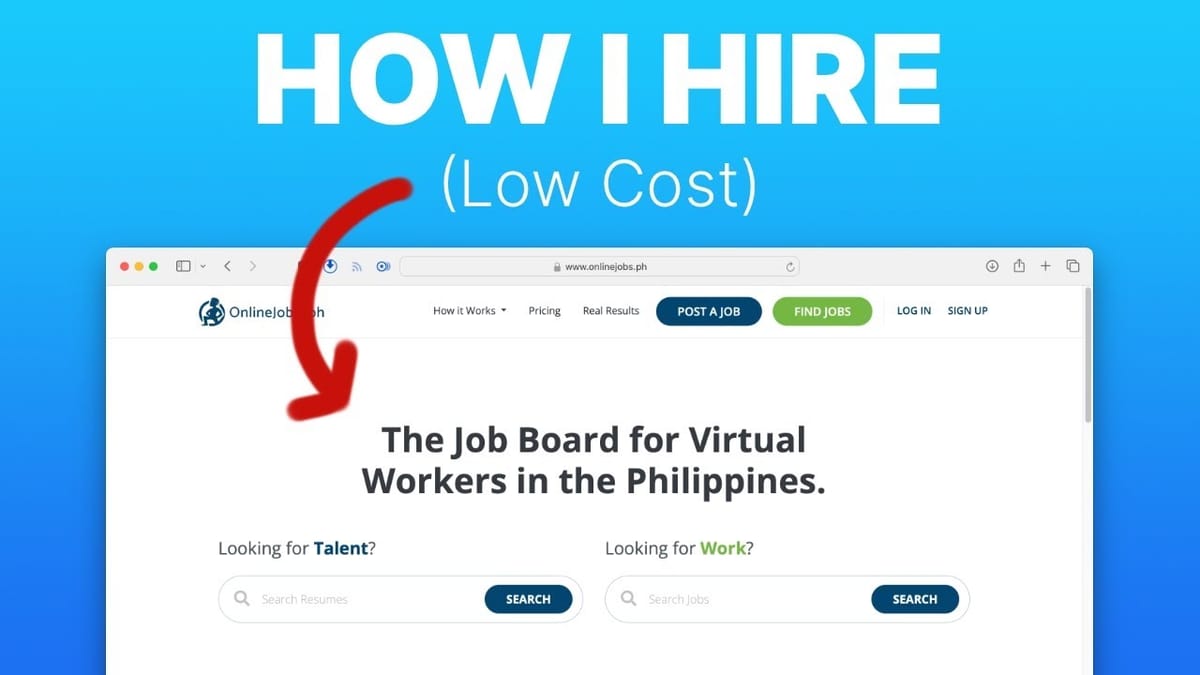
OnlineJobs.ph is the platform I use to find these workers. It functions like any other job board: you post an opening, candidates apply, and you screen them. The key difference is that every applicant is based in the Philippines, which comes with specific advantages and a few things to plan around.
The Pros and Cons of Hiring in the Philippines
The biggest advantage is cost. You can hire full-time, 40-hours-a-week workers — skilled in web development, graphic design, SEO, video editing, and more — at rates that would be impossible in the US or Europe. And because remote work eliminates brutal commutes common in the Philippines, workers genuinely appreciate these positions.
The main thing to plan for is the time zone difference. The Philippines is roughly 14 hours ahead of US Eastern time. I don't force my team to work my hours. Instead, I let them work during their normal daytime, and we sync up at the edges of our days. When I wrap up in the evening, they're just getting started, and when I wake up, I review what they accomplished overnight. It requires a bit of async discipline, but it works extremely well once you get into a rhythm.
One honest caveat: copywriting has been the one area where I haven't had consistent success with Filipino VAs. English is widely spoken but it's not the primary language, and the cultural nuances of persuasive writing for a US audience can get lost. AI writing tools have helped bridge that gap, but it's worth knowing upfront.
What Kinds of Jobs Can You Fill?
Just about anything you can imagine. I've personally hired for SEO, graphic design, video editing, and web development — and the quality has been consistently strong as long as I invest time in the screening process. The platform covers everything from administrative virtual assistants to highly technical roles.
You can search the job board directly by skill. Type in "graphic design" and you'll see a list of available workers, whether they're looking for full-time or part-time work, and their expected monthly rate. And just like any hiring process, listed rates are a starting point — negotiation is normal and expected.
How the Job Board Works
OnlineJobs.ph gives you two approaches to finding talent. You can proactively search for candidates by skill, browse profiles, and message people directly. Or you can post a job listing and let candidates come to you. I prefer posting jobs because it lets me see who follows instructions and how they communicate — two things that matter enormously when your entire working relationship will be text-based.
The platform also publishes salary guides broken down by job category, showing low, medium, and high rates. For example, a WordPress developer typically runs around $630 per month, while a project manager — who usually works hours more aligned with yours and communicates at a higher level — might cost around $850. These benchmarks are genuinely helpful when you're figuring out what to offer.
OnlineJobs.ph Pricing: What It Actually Costs
There's a free tier that lets you post up to three jobs per month, but you can't actually message or hire anyone without a paid plan. The two paid tiers are $69/month and $99/month. The premium $99 plan includes background checks, which I consider essential and will explain shortly.
Here's my strong recommendation: sign up for the annual plan. It drops the cost by up to 70%, bringing the top-tier plan down to about $350 per year. That's a no-brainer cost of doing business. More importantly, the annual plan removes the pressure to rush your hiring. I've seen too many people try to cram the entire hiring process into a single month to avoid paying for a second month, and they end up making bad hires.
Good hiring takes time. When you have the annual plan, you can afford to be patient, run extended trials, and avoid the desperation of "this one has to be the right person." That patience is what separates people who love their VA experience from those who have horror stories.
How to Post a Job That Attracts Quality Candidates
Posting a job is straightforward — fill out a simple form and applications start rolling in within 20 to 30 minutes, especially if you post during Philippine business hours. People tend to overthink the job description. My advice is to write it in natural language, exactly the way you'd communicate with someone on the job.
This matters because virtually all of your interaction with a VA will happen through text messaging. Your job post is the first test of that dynamic. Write like a human, and you'll attract candidates who communicate like humans. Overly formal, corporate-speak job posts tend to attract overly formal, template-style responses — and those rarely translate into great working relationships.
Screening Candidates: Weeding Out the Time Wasters
This is where the real work happens, and it's the step most people skip or rush through. I use three specific tactics to filter out candidates who aren't serious.
First, I set a designated subject line and explicitly state it in the job post — something like "Dynamic WordPress Developer." If someone applies without using that exact subject line, I archive the application without reading it. It tells me they either didn't read the post or they're auto-applying to everything they can find. You can even mark them as not following instructions, which notifies them for future reference.
Second, I ask for specific deliverables. For a web developer role, I'll say "send me your three best websites." Not a portfolio of 45 links — exactly three. If they can't follow that simple instruction, or if the links they send are broken, that tells me everything I need to know about their attention to detail. A web developer who can't copy and paste a working URL isn't going to thrive in my company.
Third, I ask for a resume. This one I'm more flexible on — if someone nails the first two requirements but forgets the resume, I'll simply ask them to send it along. But the subject line and the specific deliverables are non-negotiable. Any signal of carelessness in that first interaction, and I move on.
Evaluating Profiles and Employer Reviews
Once a candidate passes the initial screening, I dig into their OnlineJobs.ph profile. You'll find their hourly and monthly rate, location, and some interesting data points like online IQ test scores and personality assessments. Keep in mind that the IQ tests are administered in English, which isn't the primary language for most Filipino workers, so I wouldn't weight those too heavily. Anything over 100 is solid.
What I pay the most attention to is employer reviews. Positive reviews are relatively rare on the platform — most reviews only get written when someone had a bad experience. So when you see a candidate with genuinely positive feedback from past employers, that's a strong signal. On the flip side, negative reviews have been accurate in almost every case I've investigated. I used to give candidates a chance to explain bad reviews, but I've learned that it almost never leads to a good hire. Trust the reviews.
Background Checks: Verifying Who You're Hiring
This feature alone justifies the premium plan. OnlineJobs.ph runs identity verification that checks government ID, email address, phone number, and physical address. A 99% ID proof score means you're dealing with a verified, real person — not a scammer.
The background check also reveals some operationally important details. You can see whether a candidate uses TimeProof, the platform's built-in time tracking software. If one of your employees is showing activity on TimeProof, that's a signal they may be working multiple jobs and not giving you their full effort. You can also see how frequently someone applies for jobs — constant job applications might indicate a freelancer or an agency posing as an individual, rather than someone looking for a dedicated full-time role.
There's even an edit log showing when and how often a candidate updates their profile, plus IP address verification to confirm they're actually located where they claim to be. All of this data helps you make a much more informed decision before investing time in interviews and trials.
Messaging Applicants and Starting Conversations
After the profile checks out, I move into a conversational phase. We'll exchange several messages directly on OnlineJobs.ph before I invite them over to the team communication tool — Slack, WhatsApp, Skype, or whatever you use for instant messaging.
That first real-time chat is usually about 15 to 20 minutes. I ask about their previous work history, what kind of projects interest them, and what their personal situation is like. I also ask practical questions: What kind of computer do you have? Is your internet connection stable? These aren't small talk — they directly affect whether someone can reliably do remote work day after day. If the conversation flows well and they seem like a strong fit, I move to the next step.
Running Paid Trials: The Final Test
I always extend a paid trial before making a full-time offer. For task-based roles like video editing, I have pre-made trial projects ready to go — I upload the files and ask them to send back the finished product. For roles like web development, I get them into our project management tool, assign two or three tasks, and give them a budget of 16 to 24 hours to complete everything.
I like to mix up the trial tasks. Sometimes I'll ask them to actually build or create something. Other times I'll ask them to explain how they would approach a problem. This combination tests both their technical skills and their ability to think through challenges and communicate their reasoning.
By the end of two to three days, it's usually clear whether someone will be a good long-term fit. But don't be afraid to extend the trial if you're on the fence. Trust your gut. If someone's work quality is excellent but reliability is a concern, run a second trial week. You're making a long-term investment in a team member — an extra week of evaluation is cheap insurance against a bad hire.
Watch the Full Video
Prefer watching to reading? Check out the full video on YouTube for a complete walkthrough with live demos and commentary.
Final Verdict
OnlineJobs.ph is the best platform for hiring dedicated Filipino virtual assistants at rates that work for small businesses. The talent pool is deep, the workers are reliable, and the cost savings compared to US-based VAs are significant.
The platform itself is basic and the screening process falls entirely on you. But if you invest time in writing clear job posts and conducting proper interviews, you can build a remote team that transforms your business for a fraction of the expected cost.
Rating: 8.0 out of 10
Frequently Asked Questions
What is OnlineJobs.ph?
OnlineJobs.ph is a job board connecting employers with Filipino virtual assistants and remote workers. It is the largest platform specifically for hiring talent from the Philippines.
How much do Filipino virtual assistants cost?
Filipino VAs on OnlineJobs.ph typically charge between $3-10 per hour depending on skill level and experience. Specialized roles like developers or designers may charge more.
Is OnlineJobs.ph legitimate?
Yes, OnlineJobs.ph is a well-established platform founded by John Jonas. It has been operating since 2008 and has connected thousands of employers with Filipino remote workers.
How do you pay workers on OnlineJobs.ph?
Common payment methods include PayPal, Wise (TransferWise), direct bank transfer, or Payoneer. OnlineJobs.ph does not process payments directly since it is a job board, not a freelance marketplace.
What tasks can Filipino VAs handle?
Filipino VAs can handle a wide range of tasks including customer support, social media management, content writing, bookkeeping, web development, graphic design, and general administrative work.